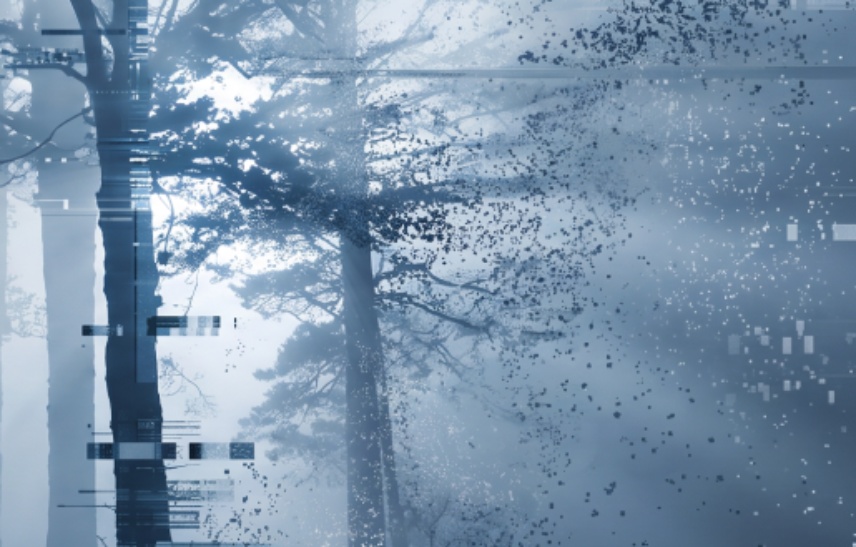
The visual identity of the 15th edition of Patchlab Festival: Dream Sim was created by Elektro Moon Vision in dialogue with the generative model Seedance 2.5. The starting point was not an AI-generated image, but a photograph: a real, imperfect frame preserving the materiality of the world and the trace of a human gaze. Only then did the process of digital interventions, transformations and animation begin. The intention was to consciously move away from the smooth, flawless and increasingly repetitive aesthetics of generative imagery in favour of rawness, grain, error, texture and imperfection.
The photographic landscape gradually loses its stability. The image breaks down into digital particles, scan lines, noise and compression artefacts, as if shifting from one state of reality into another. Fog becomes a key motif, both real and metaphorical. It acts as a transitional zone between reality, dream and simulation, while also evoking technology itself, now almost invisible and ubiquitous, like data clouds, algorithms and wireless networks operating in the background of everyday life. It remains unclear whether the digital reality is being generated or, on the contrary, disintegrating. The process of creating the image may simultaneously become a process of disappearance and information loss.
The soft, organic typographic form of Dream Sim, developed by Studio Widok, contrasts with the technological language of Patchlab’s visual identity and reflects the ambiguity of the title itself. Dream evokes both aspiration and sleep, including a dream that slips out of control; Sim refers to simulation, a tool for realising imagination, but also to a system increasingly capable of shaping it.
The light filtering through the trees prevents the image from being read as purely dystopian. It contains both promise and unease, fascination with technological possibilities and an awareness of their consequences. The collaboration with AI was not intended to replace the creative process, but to extend it. The model became one of the tools, while the direction, selection, rhythm and meaning of the image remained the result of the artists’ decisions. In this way, the process of creating the key visual reflects one of the central ideas of Dream Sim: technology acquires meaning through human intention, choice and the way it is used.