Guanaquerx
Exhibition
Guanaquerx | Paula Gaetano Adi
Curators: Carolina Pietyra, Elwira Wojtunik-Láng
Guanaquerx reimagines robotics as a tool for planetary liberation. Its point of reference is the historic crossing of the Andes by General José de San Martín’s Revolutionary Army during the struggle for Latin American independence. Two centuries later, the same route becomes the setting for a new speculative expedition, asking whether liberation might concern not only people, but also our relationships with technology and the planet.
The project was developed over two years through the collaboration of engineers, artists, craftspeople, programmers, weavers, local muleteers, and historians. It brings contemporary robotics together with Andean materials, knowledge, and symbolism. A key element is the Pluriversal Laws of Robotics, which rewrite Asimov’s laws by extending technological responsibility beyond humans to the Earth and all living beings.
Rather than proposing a new machine, Guanaquerx proposes a new scenario for a technological future. Instead of repeating the dominant dream of AI and robotics as tools of control, extraction, and expansion, the project explores a relationship based on collaboration, locality, and responsibility. It asks whether we can imagine a technological future beyond the logic of domination, and whether creating and simulating alternative models might be a first step towards making them real.
Guanaquerx was developed with support from Creative Capital, Hyundai Motor Group, and the Rhode Island School of Design.
The artwork received the Grand Prix Award at Ars Electronica 2025
The Krakow Festival Office is a co-organiser of the exhibition.

Guanaquerx. Technologies of Emancipation
Expedition Across the Andes
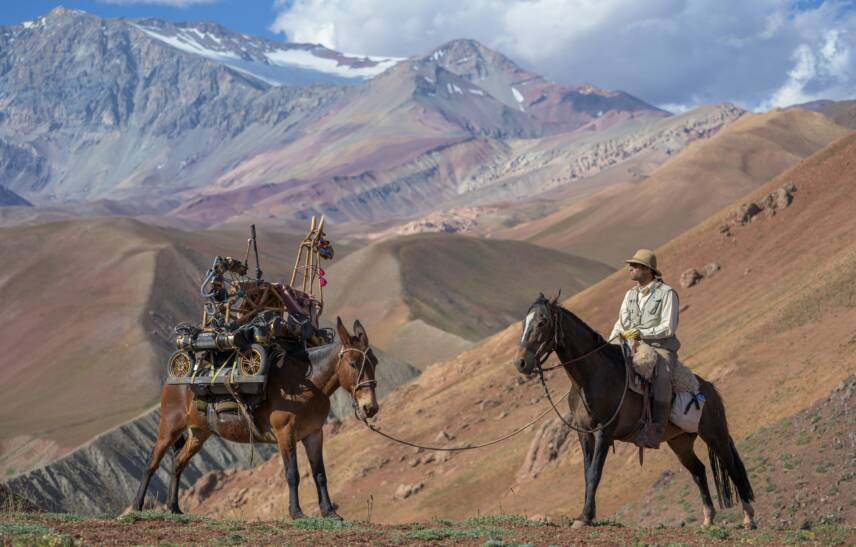
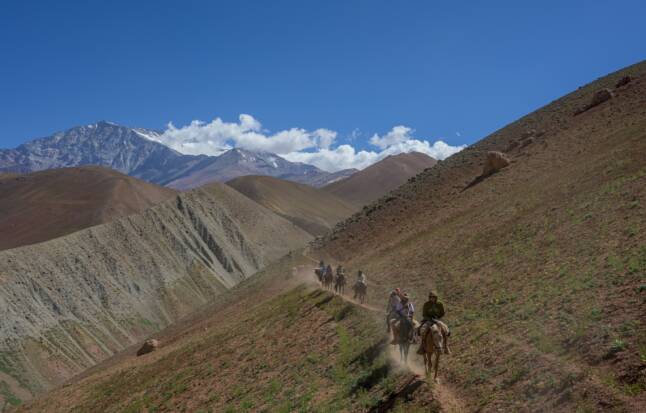
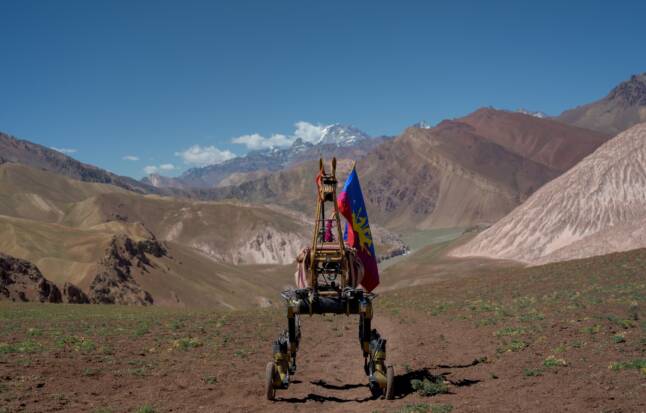
In January 2024, Guanaquerx, a quadruped robot whose form deliberately references the Andean guanaco, crossed the Andes over the course of seven days together with a group of artists, engineers, craftspeople and guides, traversing peaks over 4,500 metres high, rivers and steep mountain terrain. The expedition referred to the historic 1817 crossing of the Andes by General José de San Martín’s Army of the Andes, one of the key events in the struggle for the liberation of South America.
The aim of the project, however, was neither to recreate a historic feat nor to demonstrate technological prowess. On the contrary, the expedition showed that technology can function through cooperation and interdependence rather than through autonomy understood as complete independence from others. On difficult sections of the route, the robot was carried on the back of a mule. Nearly one hundred people took part in the project as a whole, while the expedition itself brought together around 30 people, as well as 58 horses and mules.
The exhibition challenges the dominant assumption that technology should play a subservient role and be understood primarily through its functions. From this perspective, machines are expected to perform tasks, accelerate processes, increase efficiency, replace humans or take over activities considered dangerous or monotonous. Guanaquerx instead asks what might happen if technology ceased to be understood primarily as a tool of control and optimisation.
Technology as a Relationship
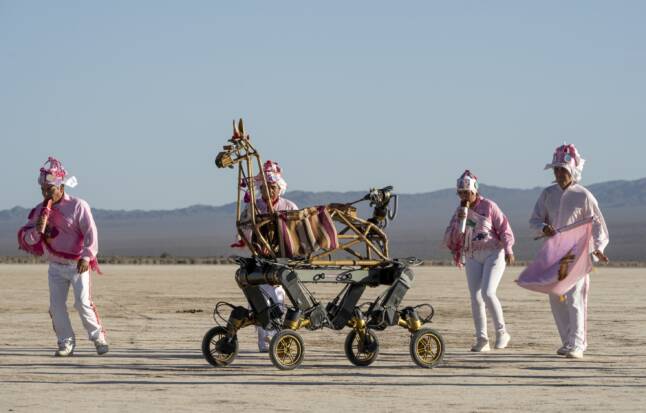
Paula Gaetano Adi’s project forms part of a broader field of inquiry around more-than-human design, an approach that does not treat the human as the sole point of reference. From this perspective, technology does not have to stand in opposition to nature. It can support interspecies relationships, take the environment into account and draw on knowledge rooted in a specific place. In Guanaquerx, advanced robotics meets Andean materials, craftsmanship and knowledge of the landscape. Its bamboo structure, textiles, mechanical tail and the flag of the “robot liberation army” form a hybrid entity that escapes conventional ideas of what technology should look like.
The history of the guanaco, the animal that inspired the project, is equally important. The relationship between humans, animals and the Andean landscape raises the question of whether technology can be designed from more than one perspective and whether it can support balance rather than exploitation.
“Technology is supposed to serve humans. To be a tool. To follow commands. To optimise processes. To increase productivity. Technology is, in fact, enslaved by us. It inherits not only our knowledge. It also inherits our hierarchies, systems of control, and our obsession with efficiency, power and domination. But culture can afford to ask a question that would sound absurd in a technology lab: what if the machine is not here to serve us? Guanaquerx grows precisely out of this idea. It is an attempt to create ‘technology otherwise’, local, collective, relational and rooted in the history of decolonisation”, explains Carolina Pietyra, Director of KBF and curator of the exhibition Guanaquerx – The Emancipation of Technology.
Although the robot that took part in the expedition itself will not be presented at Apteka Designu, it has become the starting point for a broader reflection. The exhibition invites a radical reconsideration of our relationship with technology and challenges a vision of the world organised solely around human needs. It also asks how freedom might be designed without reproducing the logic of servitude, without shifting the burden of labour onto those expected to perform it for us: robots, nature, animals or other people.
At Apteka Designu, the exhibition will present materials documenting the project and Guanaquerx’s journey across the Andes, including films, objects, research materials and expedition documentation. The exhibition offers insight into the development of the project and the ideas underlying both its artistic and technological dimensions.
Decolonising Technology
Guanaquerx – The Emancipation of Technology is also a story about decolonising technological thought. Rather than attempting to keep pace with dominant models of innovation, the project searches for an alternative: a form of technology rooted in place, local knowledge, craftsmanship and collaboration.
In this context, the expedition across the Andes becomes a kind of experiment. It brings together historical memory, the knowledge of baqueanos, local guides deeply familiar with the terrain and its routes, local materials and contemporary robotics. Technology does not appear here as a solution imposed from outside, but as the result of an encounter between different forms of knowledge and experience.
This hybridity is one of the project’s most important qualities. Guanaquerx brings together the digital and the material, the contemporary and the traditionally rooted, the human and the non-human. The point is not to choose one side over the other, but to explore the possibility of existing between them.
Guanaquerx – The Emancipation of Technology offers no ready-made answers. Instead, it proposes an exercise in imagination: what might happen if we stopped treating technology solely as a tool? Because the question of machine freedom is ultimately a question about what kind of future we want for humans, technology and the planet as a whole.
Guanaquerx WEBPAGE
_____
Guanaquerx Crew
Concept & Lead Artist
Paula Gaetano Adi
Robotic Development
John Suh, New Horizons Studio (NHS) – Head
Miguel Grassi – Guanaquerx Lead Robotics Engineer
John Strong, NHS – Lead Mechanical Design Engineer
Zach Nobles, NHS – Lead Robotics Control Systems Software Engineer
Tomas Grassi – Guanaquerx Software Engineer
Jordan Rozendal, NHS – Product Design Engineer
Michael Webber, NHS – Mechanical and Electrical Design Engineer
Pierre Maurer, NHS – Manufacturing and Test Engineer
Qotayba Alrayes, NHS – Robotics Control Systems Software Engineer
Varit (“Ohm”) Vichathorn, NHS – Robotics & Mechatronics Engineer
Henry Cole, NHS – Electrical and Electronics Design Engineer
Noah Hedding, NHS – Power Electronics R&D Engineer
Kyle Cesare, PickNik Robotics – (former) Sr. Robotics Engineer
Lovro Ivanov, PickNik Robotics – Robotics Engineer
Michael Wrock, PickNik Robotics – Robotics Scientist
Davide Faconti, PickNik Robotics – Robotics Architect
Griswald Brooks, PickNik – Senior Robotics Engineer
Mark Moll, PickNik Robotics – (former) Director of Research
Film & Video
Berny Garay Pringles – Producer and Camera Operator
Emanuel – Camera Operator
Facundo Bustamante – Sound Operator
Arturo Delgado – Drone Pilot & Operator
Pavel Romaniko – Photography
Ignacio Ceroi – Editor
Alejandro Borsani – Astrophotography & 360 Video
Artisans & Local Makers
Leo Pelegrin (Malon Bikes) – Bamboo Craftsman & Designer
Javier Bustos – Sound Artist
Hermanos Kuter – Flag Design
Teresa Diaz – Textile Artisan
Arminda Suarez – Textile Artisan
Daniela Suarez – Textile Artisan
Yanina Suarez – Textile Artisan
Pablo Martin – Textile Artisan
Gustavo Ortiz – Wood Prototyping
Isabel Perez – Flag Maker
Rosa Perez – Flag Maker
Facundo Vila – Robustito & I3D
Baqueanos & Expedition Guides
Ramon Ossa – Expedition Coordinator, Explora Parques
Diego Ossa – Expedition Lead, Explora Parques
Mario Tapia – Baqueano
Ricardo Suarez – Baqueano
Vicente Espinosa – Baqueano
Horacio Tello – Baqueano
Gaston Parra – Baqueano
Emiliano Tello – Baqueano
Eduardo Espinosa – Baqueano
Walter Valdevenite – Baqueano
Enzo Vergara – Baqueano
Tania Aguilera – Baqueana
Eugenio Tirado – Baqueano
Research Team
Martina Schilling
Ignacio Heredia
Graphic Design & Web Development
Philip Bayer
Tiger Dingsun
Educational Team
Claudio Alessio – Education Coordinator
Federico Amarfil – Instructor
Julieta Mercado – Student, Escuela Obispo Zapata
Bruno Olmos – Student, Escuela Obispo Zapata
Eliseo Rosales – Student, Escuela Obispo Zapata
Luciano Farias – Student, Escuela Obispo Zapata
Luis Farias – Student, Escuela Obispo Zapata
Ignacio Varela – Student, Escuela Obispo Zapata
Support & Production Team
Sarah Cunnigham – RISD Vice Provost, Strategic Partnerships
Miguel Lastra – Hyundai/RISD Project Manager
Danielle Lilly – RISD Office of Strategic Partnerships
Lali Gaetano – Guanaquerx Local Project Manager
Sheila Arellano, NHS – Content Creator
Zoli Kauker, New Horizons Studio – Lab Manager
Jake Bernal, New Horizons Studio – Sourcing & Procurement
Julie Park, New Horizons Studio – Chief of Staff
Kyle Kirves, PickNik Robotics – Senior Project Manager
Acknowledgments
Joanne Stryker – RISD Dean of Experimental & Foundations Studies
Miguel Licciardi – Asociación San Martiniana
Mario y Vittorio Vatteroni – Turismo Vittorio
Ivanna Rivas – Escuela Obispo Zapata
Leonardo Storniolo – Ceras San Juan
Veronica Borsani – Infographics
Franco Zacha – Yastay Illustration
Louis Hand – Design Assistant
Priscilla Ybarra – Expedition Chronicler
Ijlal Muzzafar – Expedition Chronicler
Jorge Perez – Expedition Doctor
Danzantes Virgen de Andacollo
Los Guanaqueros
Pato Marun
Pebi Zimmerman
Ing. Lucho Cernuda
Bocha Golberg
Graciela Adi & Néstor Gaetano – Life Logistics
Vicente & Ale
Deolinda Correa & Lida Hernández
Guanquerx Photo Credits:
Pavel Romaniko. Guanaquerx | Paula Gaetano Adi