Dream Sim

Main exhibition

15-18.10 | 12:00 - 18:00 Tickets | 35 PLN The Potocki Palace Gallery Vernissage: Thursday, 15.10 | 18:00
34KB

In the main exhibition Dream Sim, technologies appear not only as tools for realizing human ideas and desires, but increasingly as systems that actively participate in designing possible futures. The works move from dreams and technological promises through simulation, automation, loss of agency and prediction, toward an attempt to reclaim imagination.

Dream refers to the dream of a technological future, to dreaming as a space of imagination, and to the ability to envision something the system has not yet predicted. Sim is, on the one hand, a tool for turning these visions into reality and, on the other, a world of models, algorithms and simulations that increasingly suggest what we may see, choose, experience and expect.

The exhibition looks at the moment when the boundary between the real, the imagined and the simulated becomes increasingly blurred. Artificial intelligence generates images, voices and narratives, digital models recreate places, bodies and processes, while immersive technologies allow us to experience alternative realities. Yet it is no longer only images and spaces that are being simulated, but also communication, presence and the very possibility of acting.

What do we gain, and what do we give up in exchange for convenience, speed and automation? How can we preserve agency in the face of processes whose scale and dynamics exceed individual decisions? Dream Sim also asks whether we are still able to imagine a future other than the one the system can already predict.

Kuratorka: Elwira Wojtunik-Láng

38KB

Infinity Eggs | Vladimir Nefedov

  _PL/BY

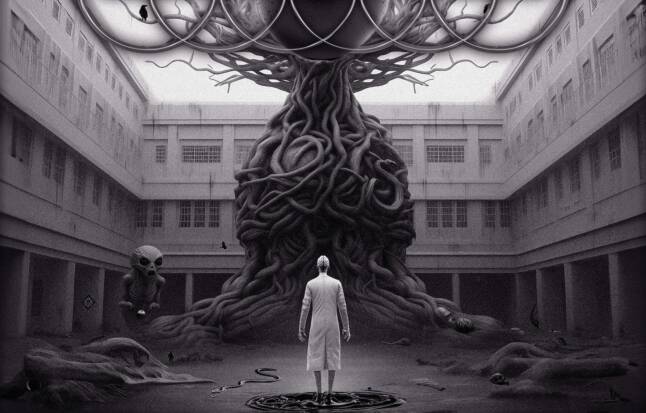
An audiovisual anthology created in 2023 entirely using early AI video generation models. It builds an experimental cosmology from unstable, fragmented images generated by neural networks. Their limitations are not concealed, but instead become the governing principle of the depicted world. Across twelve short episodes, styled as news broadcasts, children’s programmes, cosmic transmissions, and absurd propaganda, a vision emerges of an Earth taken over by an alien bureaucracy.

Bodies mutate, spaces lose continuity, and distortions and glitches become part of the political order. Early AI models were capable of generating only a few inconsistent seconds of footage at a time, so their errors shape the dramaturgy and logic of the entire universe.

The work is both a fictional world and a document of a moment when generative video was only beginning to develop its own visual languages. It also captures the early fascination with the possibilities of this technology and the promise of almost unlimited creation that accompanied it. It is a record of an early stage in the dream of technology capable of generating entire alternative realities. From today’s perspective, the unstable, imperfect images of Infinity Eggs reveal a world in which simulation no longer imitates a stable reality, but produces its own fluid rules.

Infinity Eggs has been presented as part of The Wrong Biennale, selected for the NewImages XR Distribution Market 2026, and shortlisted for the SHARE Prize XVIII.


378KB

Scent. Witnessing Without Power | Alan Kwan

  _US

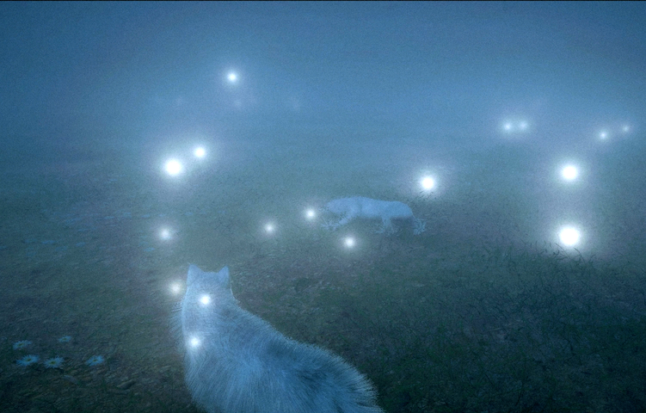
A short, cinematic game in which the player takes on the role of a dog wandering through a nameless city ravaged by war and collecting the souls of the dead. There are no missions, weapons or ways to change the course of events. The player can only move, hide and observe.

In this way, Alan Kwan reverses one of the fundamental promises of video games: agency. The controller remains in the player’s hands, but their possibilities are deliberately limited. Instead of action, the central experience becomes witnessing events over which the player has no influence. The collected souls are not points or resources leading towards victory either. They accompany the protagonist on a journey through a landscape of violence and loss.

By stripping the war of names, opposing sides and geographical references, Kwan attempts to move beyond rational explanations and reduce the experience to its sensory dimension: fear, chaos, darkness and helplessness, but also brief moments of hope.

The work reverses the logic of simulation. It offers no possibility of testing alternative scenarios or correcting reality. Instead, it places us inside a world whose rules have already been set and asks about the limits of participation in a designed reality. Can simulation bring us closer to the experience of another person’s suffering, or do we remain merely its safe observers?

The work premiered in 2025 at the Tribeca Festival. It has also received recognition including Prix Ars Electronica 2021 and NewImages Festival 2026.


249KB

Speculative AI | Birk Schmithüsen

  _DE

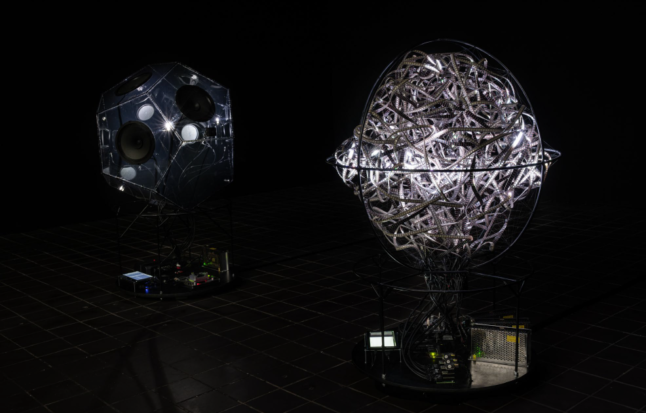
This work belongs to a series of experiments that seek to translate processes unfolding within artificial neural networks into forms accessible to human perception. The installation explores the nature of artificial intelligence by rendering otherwise invisible neural activity as light, image, and sound. At its core is AI’s ability to generalize learned rules and respond to unfamiliar data, a phenomenon the artist describes as “predictable unpredictability.”
Two independent AI systems are embodied as audiovisual objects. One receives sound and transforms it into images; the other captures images and responds with sound. The activity of the networks becomes visible through structures of light in which thousands of LEDs correspond to neuronal states, revealing how recognizable patterns gradually emerge from apparent chaos.
Within the exhibition space, the two systems engage in a constantly evolving dialogue. The work asks where the boundary lies between understanding and its simulation. Are we witnessing a genuine exchange of meaning, or simply a convincing model of communication, intention, and empathy? The human is entirely absent from this exchange: the conversation unfolds without our participation, presence, or even the need for us to remain its intended recipient.


370KB

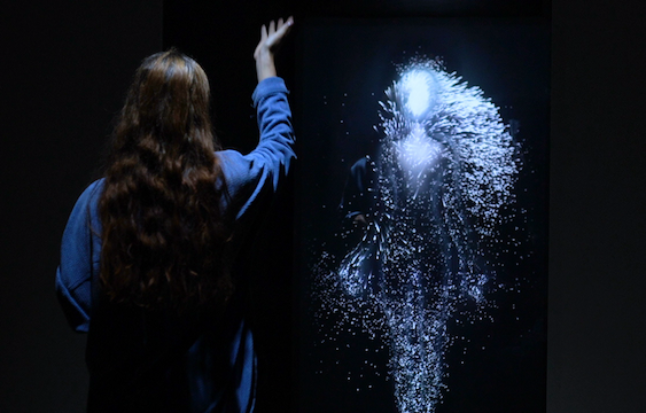
Touch is one of the first senses through which we experience the world. It is closely connected to intimacy, presence and our sense of reality, becoming a fundamental way of understanding our surroundings. Meanwhile, technology is becoming increasingly immaterial: from tools and machines, we have moved towards computers, interfaces and virtual environments that operate in ever more invisible ways.

The installation explores this paradox by asking what happens to our senses when our interaction with technology is no longer physical. In a digital mirror, the viewer sees their own reflection alongside an ethereal figure made of light, shadows and floating particles. Although the figure has no material form, its invisible boundaries can be discovered in the space, allowing the viewer to enter into an apparently tactile relationship with it. The image responds to hand movements, creating the impression that light can be grasped, moved or pushed away.

No physical touch actually occurs, yet the brain begins to construct the sensation of touch based on what it sees. The experience creates a subtle shift between seeing and feeling, raising the question of whether simulation can evoke a sensation as convincing as real physical contact. And as technology develops, are we not only learning to use new interfaces, but also learning new ways of sensing?

The project is presented in collaboration with the Hungarian Culture Center in Warsaw.


118KB

Non-Player World | Y7

  _UK

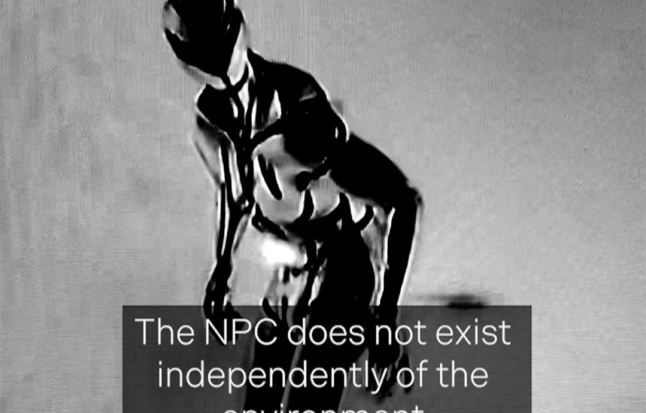
A video essay developing a speculative concept created by the duo Y7 in 2025 for MAGMA, a São Paulo-based audiovisual and publishing platform dedicated to contemporary visual culture. The concept of Non-Player World refers to contemporary socio-technical environments, systems, and phenomena that increasingly seem to no longer operate primarily with humans in mind. Its point of departure is the figure of the NPC, a game character controlled by the system. Here, the perspective is reversed: rather than the human becoming a secondary character, the world itself begins to function according to rules that are no longer designed around human perception, needs, or agency. Automation, algorithms, data infrastructures, and AI systems create environments that operate at their own pace and according to their own logic.
The work therefore asks who is actually in control of contemporary reality. Are we still its users and designers, or are we increasingly moving through a world whose rules are being shaped beyond our direct influence?

The work was created in collaboration with Centre for Research, a London-based research and design practice working at the intersection of architecture and media.


288KB

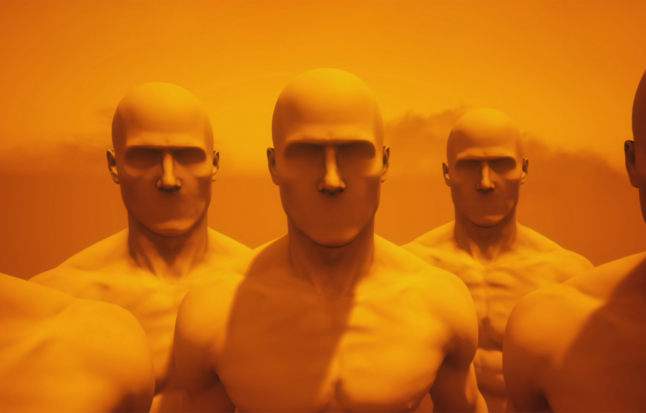
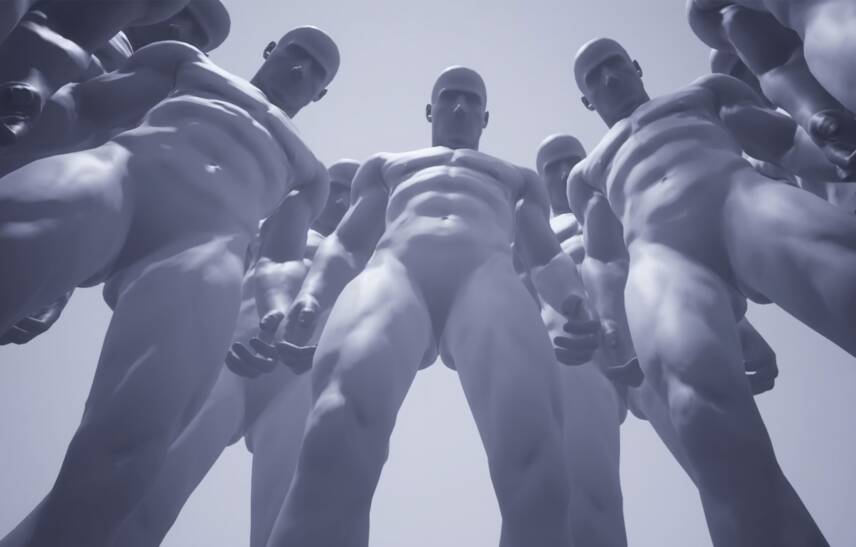
A metaphysical reflection on identity, visibility, and the fragile boundary between being and appearing. In a black-and-white, dreamlike world, metallic figures, gleaming masks, fragmented bodies, and artificial geometries drift through space. The titular Artifacts exist only for as long as they are seen, admired, and desired.

Here, images do not simply represent existence, they help bring it into being. Alongside the Artifacts are the Anonymous and the Invisible, figures who do not depend on the reflected light of other people’s gaze, but seem to possess an inner source of their own.

The work echoes Jean Baudrillard’s ideas of simulacra and hyperreality, while speaking directly to a present shaped by screens, avatars, filters, and social media. We increasingly exist through images of ourselves that are constructed, processed, circulated, and judged within digital networks. Artifacts imagines a world in which simulation is no longer layered onto reality, but becomes a condition of visibility and social existence. It asks whether we still shape our own image, or whether we are beginning to live according to the logic of the images we created.


259KB

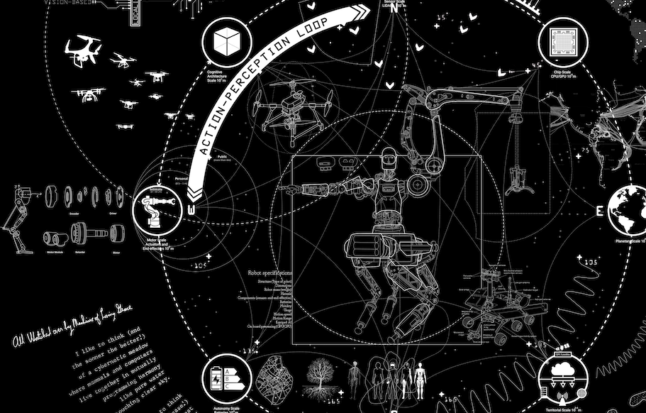
GUSTOSA (Graphic Umwelt Set Theory of Signs and Affordances) is a speculative research protocol examining relationships between humans, technologies, and the environment in a reality increasingly shaped by computational systems. The project starts from the premise that emerging technologies are no longer merely tools, but active components of complex cognitive and material systems that influence how we perceive, design, and inhabit the world.

The work maps shared spaces of meaning, agency, and semiotic exchange between humans and more-than-human technological entities. Moving across molecular, architectural, and planetary scales, it visualises networks of interdependence between different agents and their Umwelten, understood as distinct environments of perception and action.

GUSTOSA asks whether post-anthropocentric forms of coexistence can be designed. Can the simulations that increasingly mediate our experience of reality become tools for imagining new models of habitat? And what might architecture look like if it were conceived not only for humans, but together with technological and ecological actors?


38KB

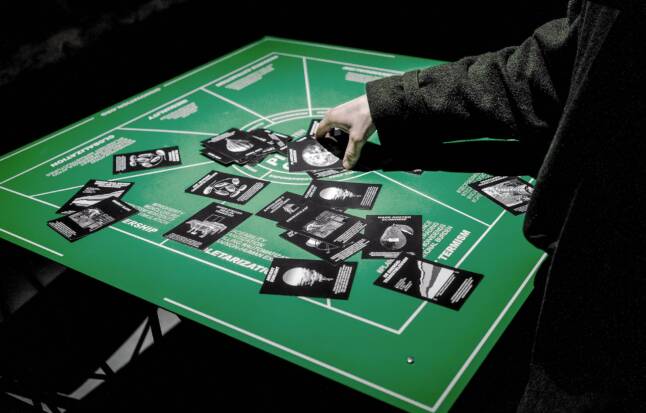
Our visions of the future are still largely shaped by the assumption that progress must mean more: more production, greater speed, new technologies, and continued expansion. Post Growth challenges this logic by confronting the idea of growth with its material consequences: rising energy and resource consumption, mounting pressure on ecosystems, and an escalating environmental crisis. It invites us to “reprogram” our thinking and move beyond the orthodoxy of economic growth.

The project by DISNOVATION.ORG brings together scientific research, speculation, and participatory practice. Rather than proposing a single ready-made scenario, it encourages us to collectively consider what forms of life and development might be possible beyond the logic of continuous expansion.

Post Growth takes the form of a strategic card game in which small groups of participants explore key concepts and possible future scenarios together. The game becomes a tool for sharing knowledge and collective discussion, helping participants navigate a world undergoing profound transformation.

The game is accompanied by an archive of interviews with researchers, theorists, and activists, expanding on ideas for alternative relationships between humans and the environment.

This work is presented in collaboration with the French Institute in Warsaw.


331KB

Unknown Label / Their Eyes | Nicolas Gourault

  _FR

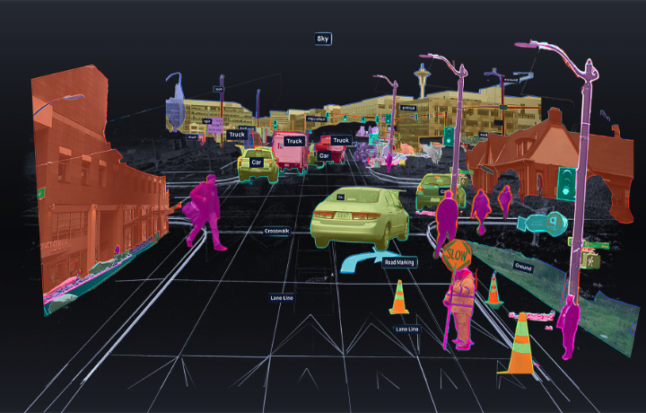
How does a machine learn to see the world? Their Eyes reveals the invisible human labour behind the AI systems used in autonomous vehicles. Clickworkers in the Global South analyse, edit, and label thousands of images of streets in the Global North, training algorithms to recognise roads, vehicles, signs, and pedestrians.

The film traces the everyday reality of this work while exposing the global inequalities embedded in the development of AI. Behind the apparent autonomy of machines lies a dispersed network of people performing repetitive, poorly paid tasks that shape how these systems learn to interpret the world. In online conversations, the workers share their experiences and devise small strategies for reclaiming agency within a system that exploits their labour.

The work asks not only how machines learn to see, but also who defines the categories through which the world is described. It makes visible the human labour concealed behind the promise of automation and shows that “intelligent” systems are inseparable from the economic, geographical, and social relations in which they are produced.

The work received an Honorary Mention at Prix Ars Electronica 2024 and the Human AI Art Award 2025. Its theatrical version, Their Eyes, was nominated for the Golden Bear in 2025 and received, among other distinctions, the IDA Award for Best Documentary.

This work was realised within the framework of a European Media Art Platform residency at werkleitz Media Art Center, co-funded by the European Union.
This presentation was co-funded by WRO Art Center.


225KB

Contrast or Illusion VR | Mariusz Borzyszkowski

  _PL

Every day, we are subject to evaluation, even though the criteria by which we are measured often remain beyond our control. The work examines a reality dominated by mechanisms of assessment, classification, and judgement. It asks why there is so little diversity among those who hold the power to evaluate others, especially when we seek change, growth, or acceptance. Is the system of evaluation truly objective and structured, or are its outcomes partly random, shaped by factors over which we have no influence?

In this VR experience, the viewer ceases to be an observer and becomes the subject of evaluation. Sixteen virtual characters assess their presence, while a random algorithm decides whether they are accepted or expelled from the digital environment. The work reverses the usual logic of interaction and confronts the viewer with a sense of dependence on a system whose rules remain unknown and beyond their control.

Duration: 3-6 min.